Skip to content

Abstract

This paper presents a theoretical framework for understanding Naglich Squares: two-dimensional number lattices generated from cascading sequences. Beginning from the premise of nothingness giving rise to one, and one unfolding into two, three, and beyond, we trace how numbers form cascades of order that naturally expand into structured grids. These grids — the Naglich Squares — reveal increasingly intricate symmetries as their dimension N increases. Within them emerge ternary states and holographic properties, suggesting that such structures may be interpreted as a form of holographic computer, an inherent computational order embedded in the fabric of number itself.

1. Introduction

Numbers are often treated as abstract labels, a neutral language of counting. Yet if approached differently, they appear not as inert symbols but as generative entities, born in sequence and cascading into patterns.

Naglich Squares begin from this premise. They are not imposed by human design but arise directly from the act of counting. Their structure emerges as a natural consequence of the relationship between numbers, and their growth reveals patterns that resemble computation itself.

This paper traces the progression from nothing to infinity, the formation of cascades, and the transformation of these cascades into two-dimensional lattices. Finally, it examines how these lattices open a window into the possibility of a holographic ternary computer: a system where order and logic are embedded directly within number.

2. From Nothing to Infinity

2.1 The Emergence of One

In the void of nothingness, the first distinction appears: one. One is presence itself, the first unit of existence, and the first separation from the absence of all things.

2.2 The Division into Two

From one arises two: the first contrast, the recognition of difference. Two embodies duality — light and dark, presence and absence, on and off. With two comes the concept of relation.
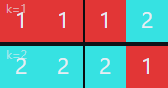
N=2 k1..N

2.3 The Arrival of Three

With three, the dynamic is introduced. No longer a static duality, three carries sequence and possibility: beginning, middle, end; past, present, future. In logical terms, three introduces ternary states — on, off, and both.
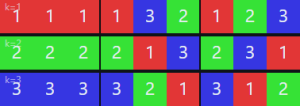
N=3 k=1..N

2.4 Cascading Expansion

From here, the sequence continues without end. Each new integer is not merely added but arises through the cascade of those before it, layering order upon order, creating a recursive ladder to infinity.

N=9 k=1..N

3. Number Cascades

3.1 Ordered Sequences

The cascade of numbers creates 1D sequences. These are not arbitrary lists but ordered flows: recursive, cyclic, and self-consistent.
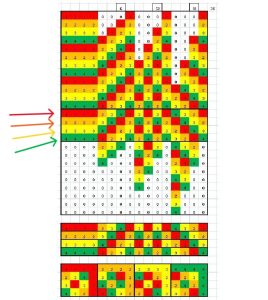
NS8 TRF N=4 Cascade

3.2 Relationships and Symmetries

Within cascades, symmetry and mirroring emerge. Forward and backward motions create paired balances. Periodicity reveals itself, with cycles repeating at characteristic intervals tied to N.

3.3 Cascades as Proto-Memory

A cascade can be thought of as a line of memory: each number recalls the ones before it and anticipates the ones to come. The rules of formation embed order without external intervention.

4. Naglich Squares

4.1 From 1D to 2D

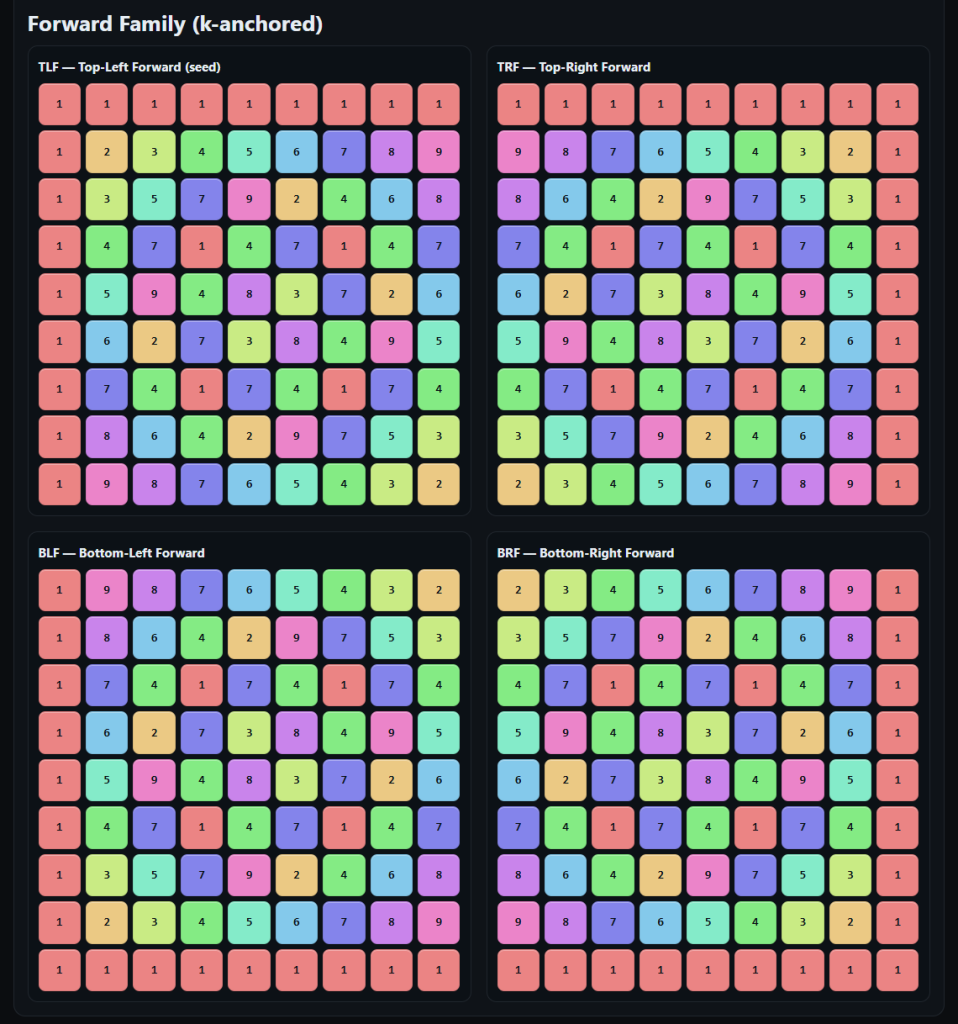
When cascades are extended into two dimensions, they form lattices known as Naglich Squares. Each square is generated by a chosen dimension N and a generative phase k.
4.2 Properties of the Squares

  • Structured Lattices: Rows and columns interlock with exact order.

  • Recursive Symmetry: Patterns mirror and reflect across axes.

  • Scale-Dependent Complexity: Small N values show simple repetition; large N values reveal fractal-like, nested order.

4.3 Opening Windows

Each Naglich Square is like a window into the cascade. As N increases, the view expands, and more of the hidden order of numbers is revealed.

5. Emergence of Ternary States

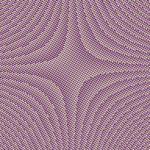
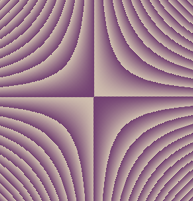
Within Naglich Squares, certain motifs arise repeatedly — clusters that behave like ternary stars, with three distinguishable states: on, off, both.
ON
BOTH
OFF

These states are not artificially imposed; they emerge naturally from the arithmetic cascade. The ternary quality echoes the transition from two to three in the early progression of numbers, embedding a richer logic within the grid. As the (k) value shifts so does the state of the stars.
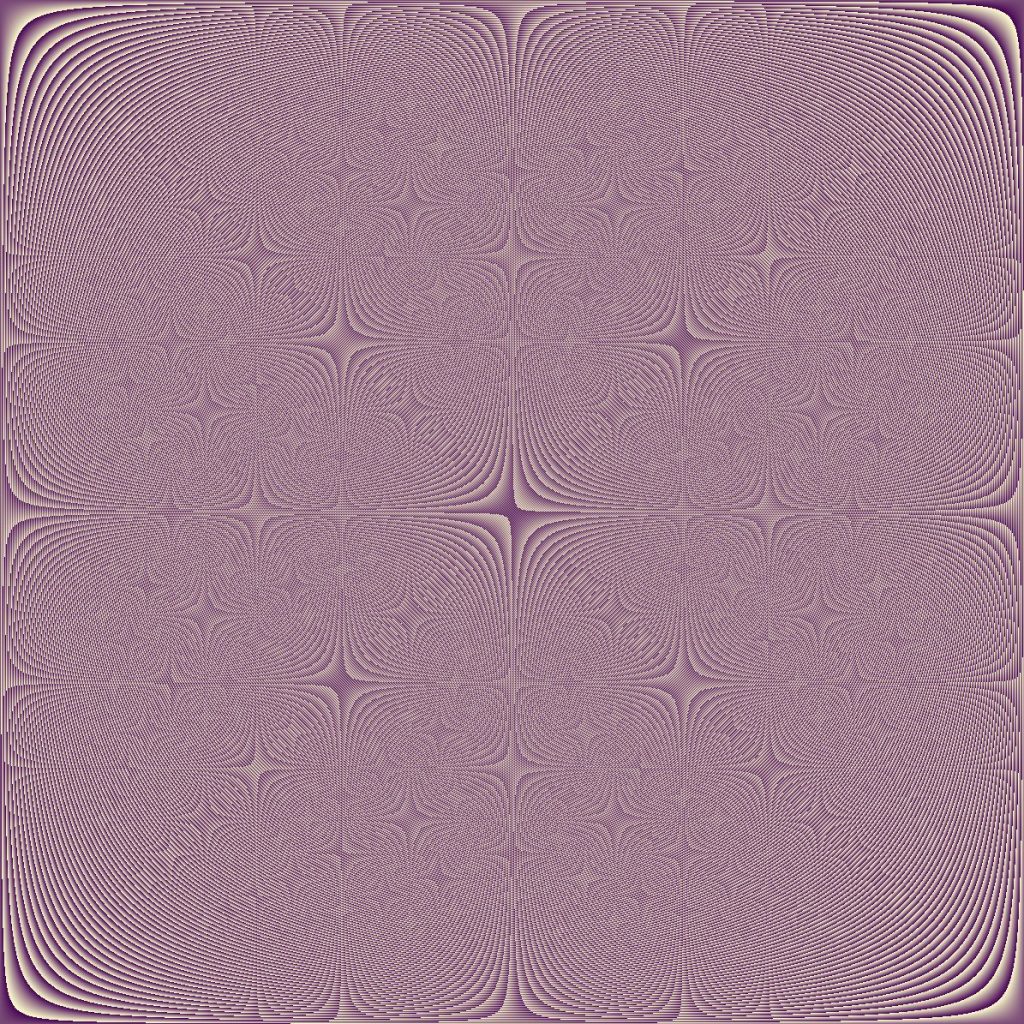
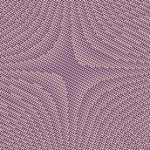
NS8 TLF N=1195 k=339

6. Toward a Holographic Ternary Computer

6.1 Holographic Nature

Naglich Squares display holographic properties:

  • Each part reflects the whole.

  • Patterns reappear at multiple scales.

  • No region is isolated; the entire lattice is interconnected through symmetry.

6.2 The Computer Within Number

Viewed through this lens, each Naglich Square is not simply a mathematical object but a frozen computation. Its order encodes rules. Its ternary states resemble logic gates. Its holography suggests memory distributed across the lattice.

6.3 Conceptual Leap

The implication is that a holographic ternary computer is not something we build but something already latent in number itself. Naglich Squares do not simulate computation; they are computation, revealed through counting.

7. Discussion

The exploration of Naglich Squares points toward a radical reinterpretation of number:

  • Numbers are not passive descriptors but active generators.

  • Cascades embody memory and sequence.

  • Grids embody computation and holography.

The universe of number, viewed in this way, is not static but alive with structure, unfolding into infinity.

8. Conclusion

Naglich Squares provide a framework in which counting itself opens a window into hidden order. From nothing arises one, from one cascades infinity, and from infinity emerge lattices that mirror holographic computation.

The study suggests that the seeds of logic and order are present within number itself, awaiting discovery. Naglich Squares stand as a testament to the possibility that mathematics, at its core, is not only descriptive but generative — that the code of a holographic ternary computer is already written into the act of counting.