Abstract
When you first encounter NS8 (Naglich Squares), it might look like just another multiplication table. But the two are very different in how they behave, what they reveal, and the kinds of patterns they expose. Here’s a breakdown.
1. Output Range
Multiplication table: Entries grow without bound. A cell at row r and column c is simply r × c, which can reach as large as N × N.
NS8: Every entry is wrapped into the fixed range 1..N using modular arithmetic. Nothing exceeds N.
2. Formula & the “Phase” Knob
Multiplication table: The formula is static—just r × c. There’s no way to shift or animate it.
NS8: Uses a multiplication-like formula, reduced mod N, with an added parameter k (the “phase”):
A(r,c,k,N)=((r−1)⋅(column term)+(k−1))modN+1
Increasing k by 1 advances every cell label by +1 (mod N), so the same grid cycles through N distinct “frames.” It’s like watching the table animate in slow motion.
3. The Eight Seeds
Multiplication table: Just one layout.
NS8: A family of eight related layouts, or “seeds,” created by applying mirrors and rotations to the base formula. They’re mathematically equivalent but visually distinct, making symmetries, tilings, and star shapes easier to spot.
4. Visual Structure
Multiplication table: Mostly about arithmetic growth—rows of multiples, columns of multiples, and diagonals tied to factors.
NS8: Shows periodic geometry. Because of modular wrapping, you get m×m windows, checkerboards, and star lattices. The exact look is dictated by the prime factorization of N. (For example, powers of 2 give very crisp checkerboard-like symmetry.)
5. Dynamics: How It Changes
Multiplication table: Static; no built-in way to explore its dynamics.
NS8: Animate k from 1..N and the grid cycles. Features appear and flip in sync (or out of sync), depending on N’s prime factors. This interplay is like gears meshing, a direct echo of the Chinese Remainder Theorem.
6. Rows and Columns
- Multiplication table: Row r is multiples of r, column c is multiples of c. Both grow unbounded.
- NS8: Rows and columns form mod-N progressions. Often, they become full permutations of 1..N (especially when the row or column index is coprime to N). That’s why every number reappears, tightly ordered, across the table.
7. Multiplication Mod N: The Close Cousin
If you take a normal multiplication table and reduce every entry mod N (mapping 0 to N), you get something close to one NS8 grid:
Both are wrapped into 1..N.
Both show repetition and symmetry.
But NS8 adds three crucial extras:
The phase knob k, which shifts the whole table at once.
The curated seed variants, which deliberately mirror/rotate the layouts.
A consistent 1-indexed format that emphasizes symmetry.
Think of NS8 as “multiplication-mod-N, dressed for pattern-finding.”
8. Multiplication mod N vs. NS8 (Side-by-Side)
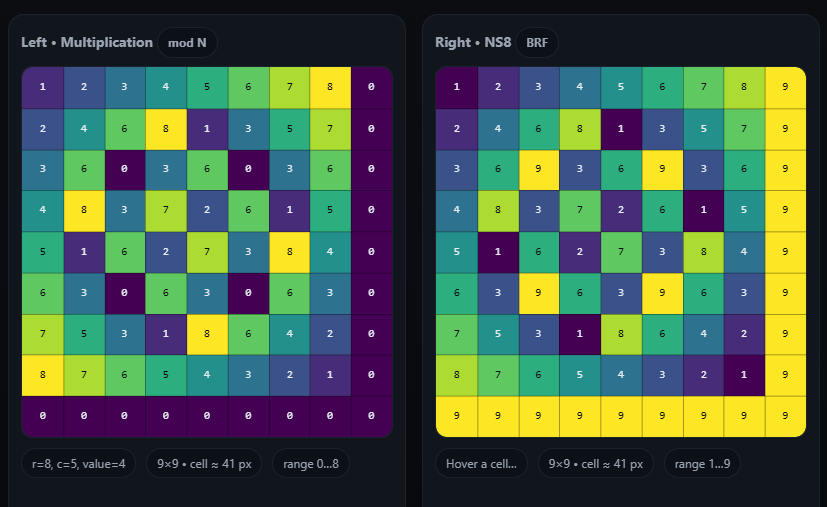
To really see the difference, let’s compare two grids at N=9N=9N=9:
Left: A standard multiplication table, reduced mod 9.
Right: An NS8 grid using the BRF seed, N=9,k=9N=9, k=9N=9,k=9.

What jumps out?
Zeros vs. Full Coverage
The multiplication table includes zeros (since multiples of 9 vanish mod 9). In contrast, NS8 remaps every value into the range 1..N, so there are no gaps.Row Behavior
In the multiplication table, some rows collapse into short cycles (like row 3: 3, 6, 0, 3, 6, …). In NS8, every row and column is a permutation of 1..9, which keeps the grid tightly ordered.Symmetry
Multiplication mod 9 shows patchy repetition, mostly where factors of 9 dominate. NS8, by design, produces balanced, geometric symmetry — diagonals, windows, and stars stand out clearly.Dynamics
The multiplication table is static: one picture, frozen. NS8 has an extra “phase” parameter kkk. Sweeping through k=1..Nk=1..Nk=1..N animates the grid as labels shift together in cycles.
9. Conclusion
A plain multiplication table grows; NS8 wraps. A plain table is static; NS8 cycles with a phase knob k. A plain table shows magnitude; NS8 reveals geometry—windows, checkerboards, and star lattices shaped by N’s prime factors. If you’ve ever built a multiplication table mod N, you’ve already glimpsed NS8’s essence. The difference is that NS8 makes the hidden order visible, coherent, and dynamic.